

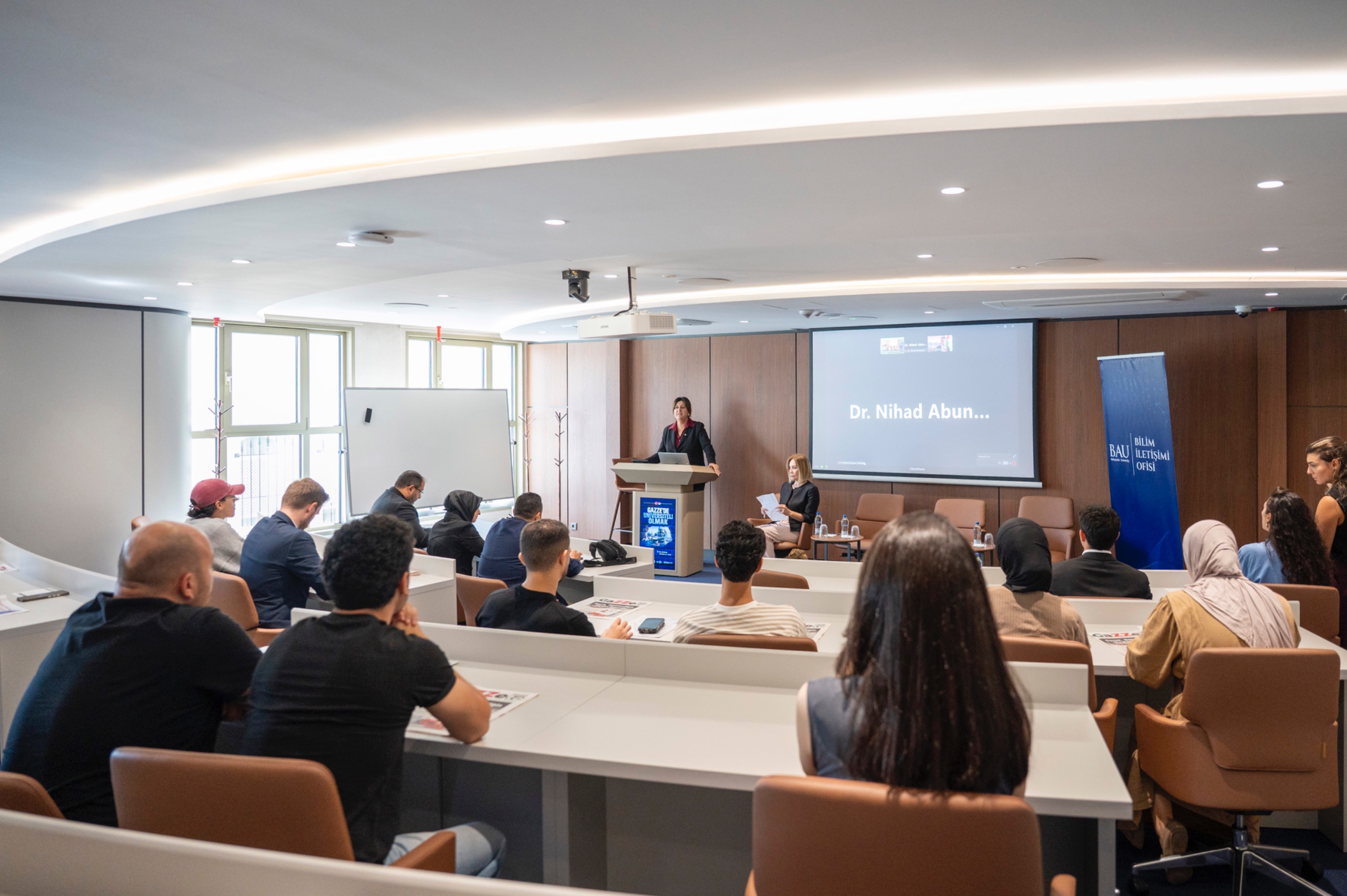
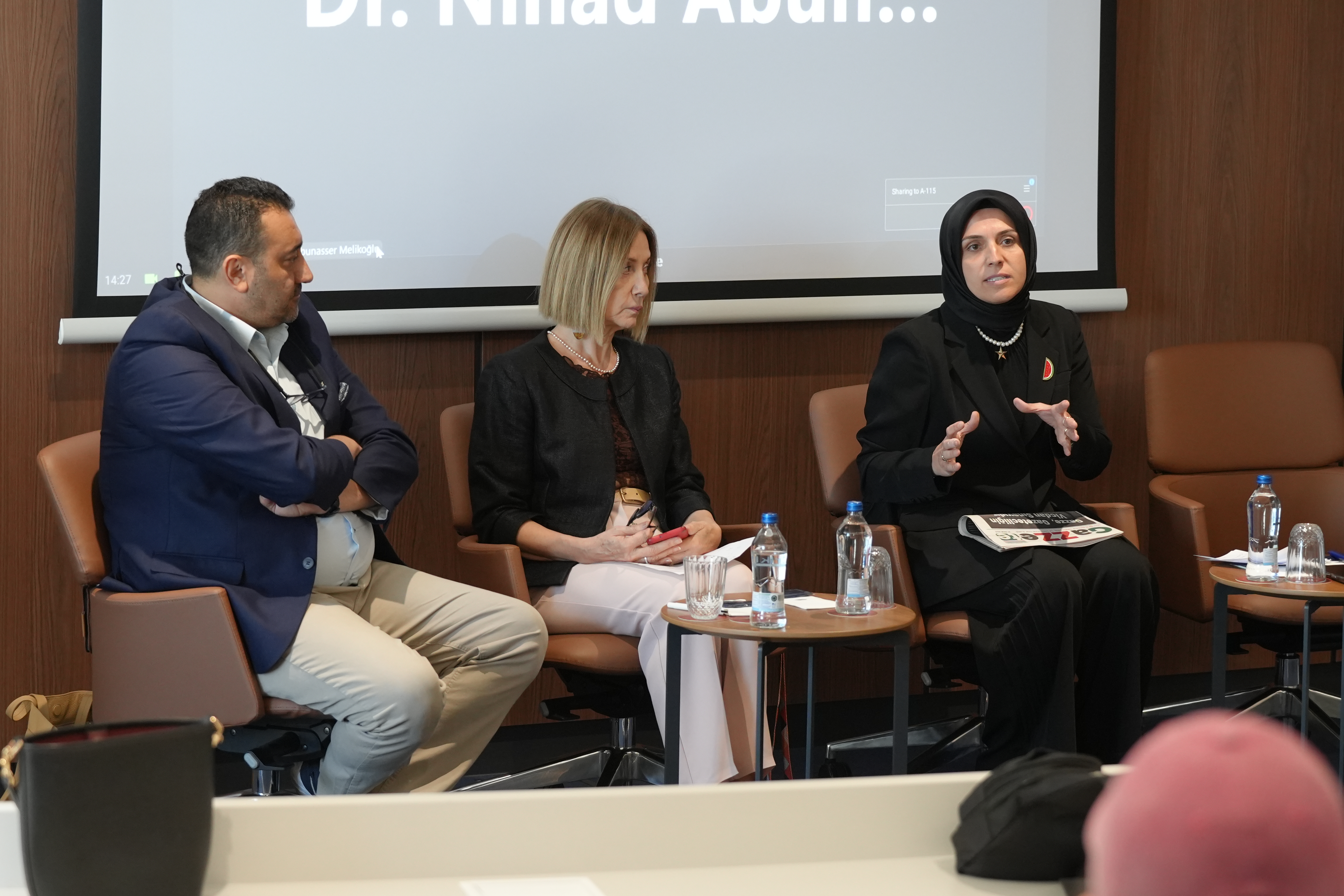
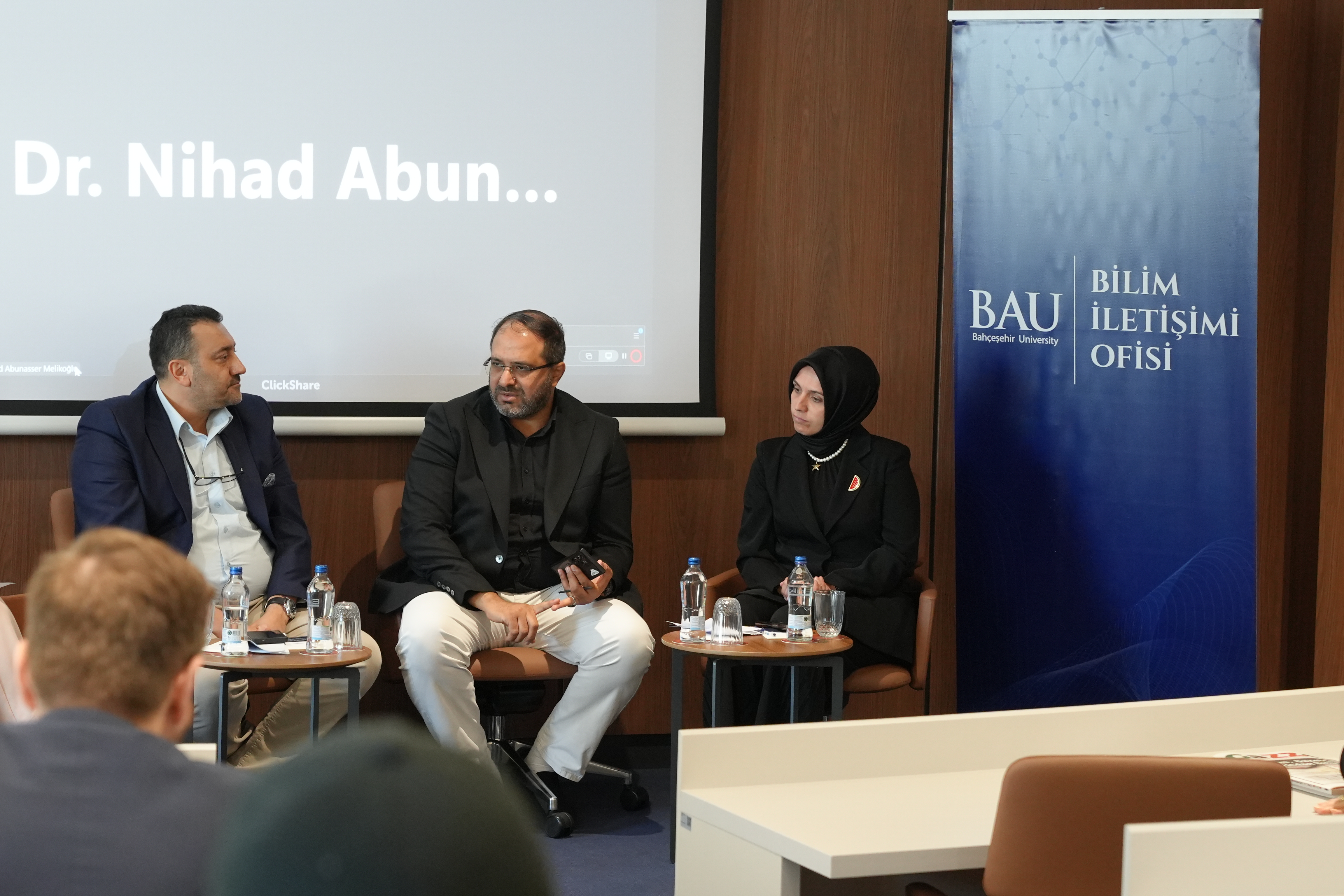
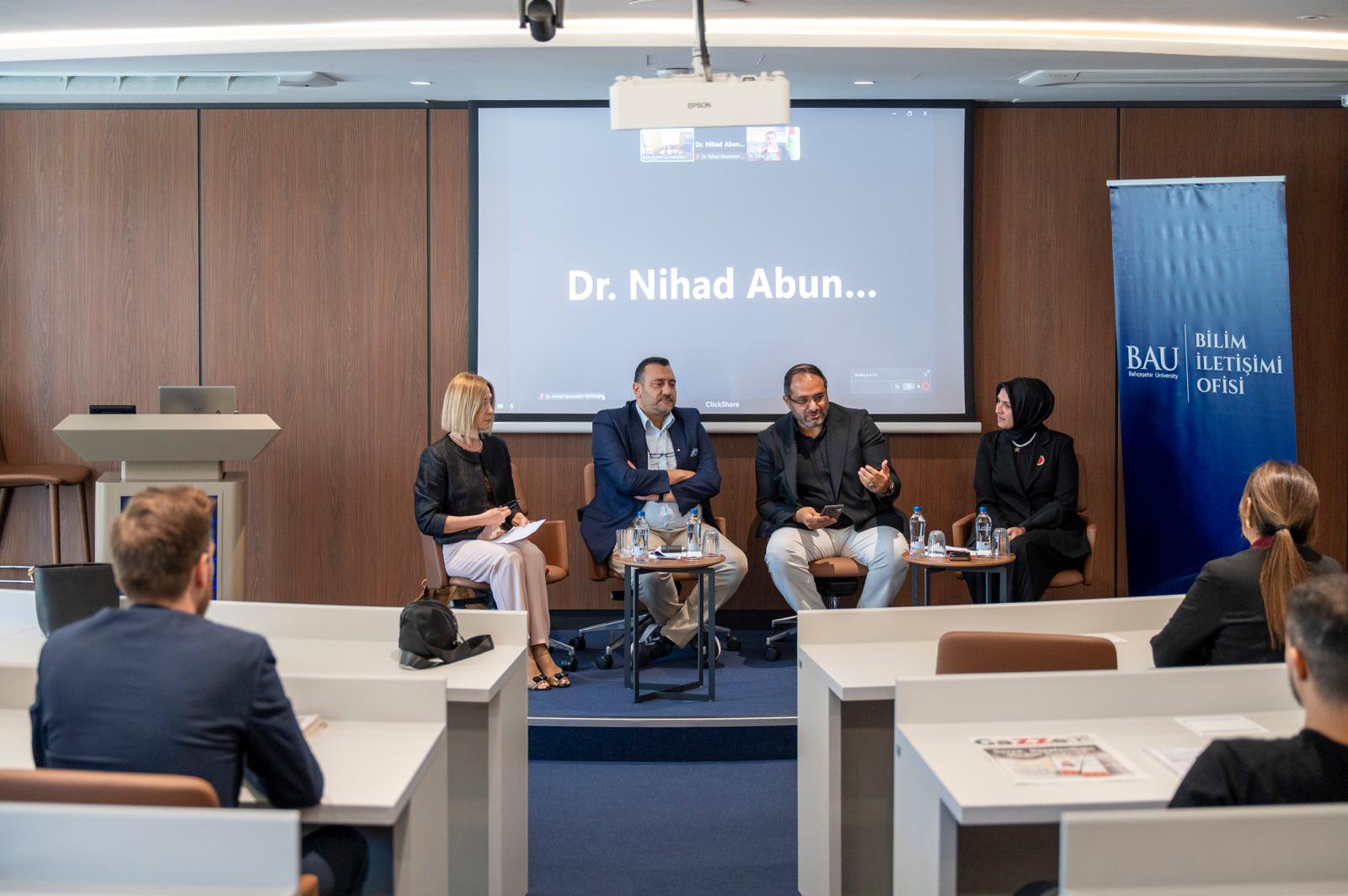
Bahçeşehir University (BAU) held a panel titled “Being a University Student in Gaza” as part of the “Science Café” event. The opening speech of the event was delivered by Prof. Dr. Esra Hatipoğlu, and Journalist Cahide Hayrunnisa Çiçek and Palestinian academics participated as panelists.
The panel titled “Being a University Student in Gaza,” held within the scope of the “Science Café” events, took place at Bahçeşehir University South Campus. The opening speech of the event, where topics such as student and academic life in Gaza, the continuation of university life under current conditions, the sustainability of education, and academic solidarity were discussed, was delivered by BAU Rector Prof. Dr. Esra Hatipoğlu.
In the event held in line with the call by the Council of Higher Education (YÖK) for universities to organize Science Café events on Gaza, President of the Palestinian Journalists Association Dr. Amir Lafi, Journalist Cahide Hayrunnisa Çiçek, and Islamic University of Gaza Public Relations Director Maisara Al Qishawi participated as panelists. The panel, moderated by TOSAM Director Prof. Dr. Nilüfer Narlı, also included Palestinian academics Dr. Nihad Abdunnasser and Dr. Zahir Elbeyk, who joined online.
Delivering the opening speech of the panel, Prof. Dr. Esra Hatipoğlu said:
“What is happening in Gaza shows how fragile higher education can be, while also revealing why education and knowledge are indispensable. Trying to maintain academic activity under conditions where access to security, shelter, communication, and even basic needs has become difficult is beyond continuing a profession; it is an effort to protect social memory, intellectual accumulation, and possibilities for the future.
Therefore, discussing what it means to be an academic in Gaza is not only about trying to understand today’s conditions, but also about debating the role of universities during periods of war, conflict, and humanitarian crises; how the right to education can be protected; and what kind of solidarity the international academic community can develop.”
JOURNALISTS AND ACADEMIA
One of the panelists, Journalist Cahide Hayrunnisa Çiçek, drew attention to the importance of journalism and academia for the memory of societies. Stating that Gaza’s memory would be preserved by journalists and academia, Çiçek noted that many journalists had been killed in Gaza and emphasized the importance of giving Palestinian academics the opportunity to tell what happened.
“THE LITERACY RATE IN GAZA WAS 99 PERCENT”
President of the Palestinian Journalists Association Dr. Amir Lafi, who works as a journalist despite having received medical education, evaluated the general situation in Gaza during his speech at the panel. Stating that the ceasefire in Gaza was not actually being experienced in practice, Lafi said that Israel had done everything to eliminate living conditions in Gaza. Dr. Amir Lafi stated that Israel did not allow many products to enter Gaza, that a large portion of agricultural lands had been occupied, and that fishing had been prevented. Noting that Israel had also done everything in its power to prevent education, Lafi said, “Before the war, the literacy rate in Gaza was 99 percent. During the war, we had students who were deprived of school. Ninety-eight percent of our schools were either completely or partially destroyed,” expressing that Israel wanted to leave Gazans ignorant.
A SCHOOL WHERE 20,000 STUDENTS WERE EDUCATED WAS DESTROYED BY BOMBS
Islamic University of Gaza Public Relations Director Maisara Al Qishawi also stated in his speech that great importance is attached to education in Palestine, and said that Israel had created serious difficulties in terms of education since 1948. Al Qishawi stated that the Islamic University of Gaza was established in 1978 with a single professor and two departments, and that before the most recent war, the university had reached 70 professors, 11 faculties, and 20,000 students. Al Qishawi explained that Israel bombed and destroyed the university campuses and the hospital where students also received education during the war. Stating that education in Gaza had not stopped despite everything that happened, and that students continued their education online, Maisara Al Qishawi said that after the ceasefire was achieved, face-to-face education had reached 80 percent.
“THE PROBLEMS OF ACADEMICS IN GAZA BEGIN WHEN THEY ARE STUDENTS”
Palestinian Dr. Nihad Abdunnasser, who graduated from Hacettepe University Department of Computer Engineering and completed his doctoral education at Yıldırım Beyazıt University, also joined the panel online. In his speech, Abdunnasser stated that the problems of being an academic in Gaza begin during the student years. Abdunnasser explained that after leaving through the Rafah Border Crossing, the only route through which Gaza opens to the world for education abroad, they could not return to their countries before completing their education. Abdunnasser, who said that he lost his mother while studying in Türkiye, stated that he could not return to his country in order not to interrupt his education. Emphasizing that great importance is attached to education in Palestine, Dr. Nihad Abdunnasser said that opportunities were offered abroad so that students would not return to their countries, but that most Palestinian students returned to their homeland after completing their education. Abdunnasser stated that their love for Palestinian lands was their motivation in coping with difficulties, and emphasized that academics living in Gaza were struggling for education in their country under harsh conditions, saying, “Today, you can see an academic in Gaza in a water queue, in a food queue, living in tents.” Abdunnasser also added that winter was approaching and that life in Gaza was becoming more difficult.
“HUNGER HAS NOW BECOME NORMALIZED; SEND US EDUCATIONAL MATERIALS”
Another speaker who joined the panel online, Dr. Zahir Elbeyk, referred to the title “Being a University Student in Gaza” and said, “What happens if you become an academic in Gaza? You become a martyr, you become a veteran, you become a mujahid. We are struggling there through education.” Stating that relatives who called him from Gaza requested educational materials, Elbeyk continued as follows: “In the messages I receive from Gaza, they say, ‘Hunger has now become normalized. We have become used to the scarcity of food. We can tolerate this. Send us educational materials.’ Education is very important to us. Israel did not only commit genocide in Gaza; it also committed educational genocide. Before the war, there were 12 universities in a small place like Gaza. They destroyed all of them. Academics were treasures for us; we lost more than 200 academics in the attacks. Islamic University Rector Prof. Dr. Sufyan Tayeh was martyred together with 72 members of his family.”
At the end of the panel, footage was also shown of the moment when the Islamic University of Gaza and the Türkiye-Palestine Friendship Hospital, built by TİKA and used by the university as its faculty of medicine, were bombed by Israel.
Tarih: 23.09.2026